"How long until this gets fixed?"
That question used to freeze waterfront deals in Coral Gables before they got to the closing table. Whether a seawall was failing wasn't the hard part. A marine contractor can tell you that in an afternoon, tapping the cap and checking for voids in the soil behind it. The hard part was the timeline, because until recently, the honest answer in Miami-Dade County was that nobody really knew. It could take six months. It could take two years. Buyers' attorneys who had closed a few of these deals knew exactly how to turn that uncertainty into a price concession.
That question now has a real answer, and it's short enough to change how the conversation goes.
The Number Every Closing Attorney Used to Quote
For years, Miami-Dade County's review process for Class I seawall and bulkhead permits commonly stretched to 18 to 24 months. Neighboring Broward and Palm Beach counties were routinely deciding comparable applications in 3 to 6 months, a gap wide enough that it became something contractors and real estate attorneys simply built into their planning.
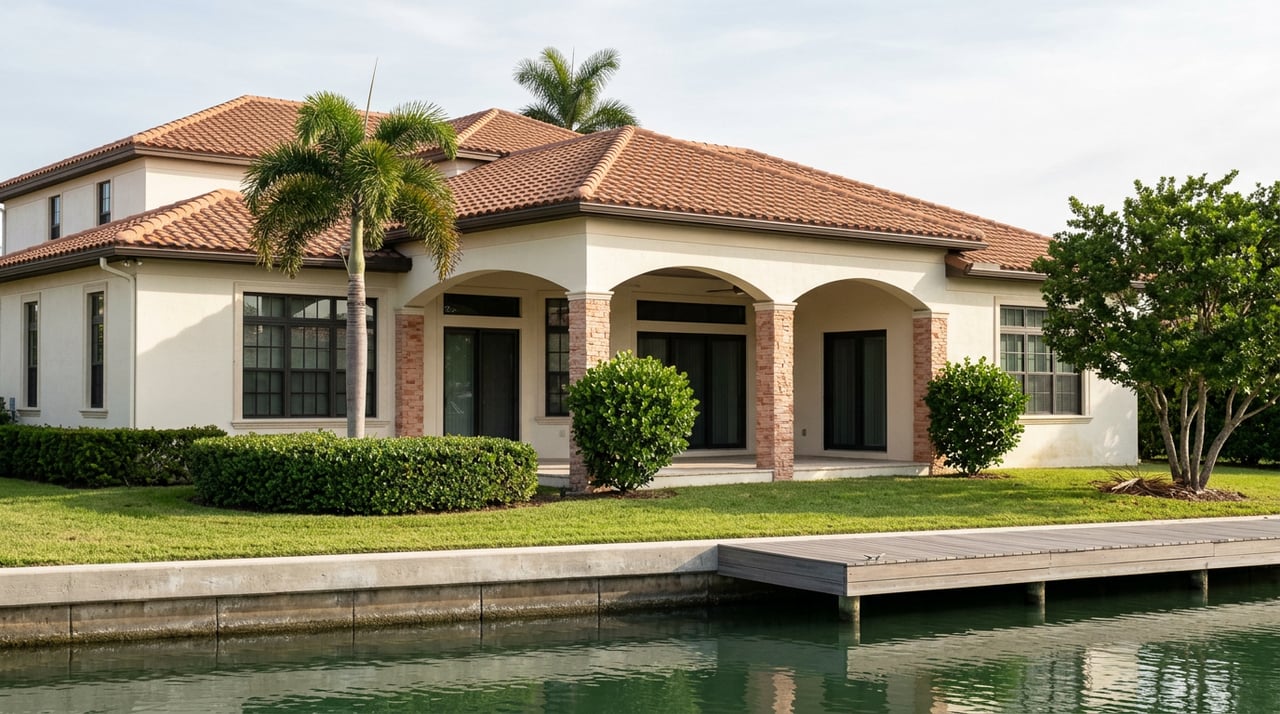
In Coral Gables, that gap mattered more than in most places. In enclaves like Cocoplum, Gables Estates, Tahiti Beach, and Gables by the Sea, the seawall isn't a landscaping feature. It's the literal boundary of the lot, holding back the canal that gives these homes their dockage and their price premium in the first place. When a wall's cap was cracking or the fill behind it had started to wash out, a seller couldn't simply hand over a contractor's repair estimate. They had to hand over an estimate plus an open-ended permitting horizon that nobody could put a date on. Buyers priced in that uncertainty, not the cost of the concrete.
What Changed on July 1
On July 1, 2025, the Miami-Dade Board of County Commissioners unanimously approved Ordinance No. 25-73, a seawall permit reform sponsored by Commissioner Eileen Higgins of District 5. The ordinance replaced the old open-ended review with a series of enforceable clocks:
Step | Requirement |
|---|---|
Completeness review | County must issue a Completeness Summary within 10 days |
Additional information requests | Limited to a maximum of 3 rounds, 10-day response window each |
Final decision | Required within 90 days of the Completeness Summary |
Permit modifications | Must be reviewed within 30 days |
These are legal deadlines rather than internal targets, enforced through the county's new Gold Key digital permitting system, which is now fully operational and applies to every new seawall filing that comes through Miami-Dade's Department of Regulatory and Economic Resources. The reform also widened the door for short-form administrative approvals and created a faster path for nature-based alternatives, including the 3D-printed marine habitat panels developed by the Miami startup Kind Designs.
Coral Gables Was in the Room
Before the vote, Commissioner Higgins convened a stakeholder roundtable that pulled in county environmental staff, seawall contractors, Kind Designs, and representatives from two cities specifically: Coral Gables and Miami Beach. That detail matters more than it might look. Coral Gables has some of the densest privately owned canal frontage in the county, concentrated almost entirely in its gated waterfront enclaves, so the city had a direct hand in shaping a rule it now has to live under more than most.
"This legislation is a game-changer," said Anya Freeman, CEO of Kind Designs.
That kind of endorsement from a company building alternative seawall technology is a signal that the reform was written with actual waterfront construction in mind, not just permitting paperwork.
Where This Actually Shows Up in a Transaction
Cocoplum, Gables Estates, Tahiti Beach, and Gables by the Sea are the four names that come up whenever a Coral Gables listing involves real water access, and in all four, a private seawall is standard equipment rather than a luxury add-on. In 2025, canal-front sales in Gables by the Sea mostly closed between $3.5 million and $6.5 million, with the widest, deepest lots reaching past $8 million. At that price point, the seawall isn't a line item buried in the inspection report. It's tied directly to how much dock the property supports, what size vessel can moor there, and how much of the purchase price a buyer is willing to protect against future repair costs.
What Changes at the Negotiating Table
Here is the part that actually matters for anyone selling waterfront in Coral Gables right now. Before this ordinance, a seller with an aging seawall faced a bad choice: pay to replace it before listing, tying up capital on a wall that might have years of life left, or list as-is and accept that a buyer's attorney would treat the repair as an open-ended risk worth a steep discount, not because the repair itself was expensive but because nobody could say when it would be finished.
The 90-day window after a Completeness Summary changes that calculation. A seawall repair can now be presented the way a roof replacement or an aging AC system already is: a known cost with a schedulable timeline, backed by an engineer's report and a permit calendar with real dates attached. That's a fundamentally different negotiation than "we don't know when this gets fixed."
It's worth being precise about the limits here. The 90-day clock covers the portion of the process the county controls directly. If a proposed seawall extends further into the waterway than the one it's replacing, typically more than a small offset from the existing wall, the project can trigger separate review from the Florida Department of Environmental Protection or the U.S. Army Corps of Engineers, and those agencies run on their own timelines outside the county's new rule. Most straightforward repairs and in-place replacements stay within the county's bounded process. Larger reconfigurations don't automatically get the same guarantee.
Before You List: What a Coral Gables Waterfront Seller Should Actually Do
Get the seawall assessed by a marine engineer or licensed contractor before you go to market, not after an offer comes in. A written report on cap condition, tieback integrity, and any voids behind the wall turns a vague disclosure into a specific, defensible fact.
Pull the parcel's existing permit history through the county's system so a buyer's attorney can see exactly what work was previously authorized and when. Sellers in enclaves governed by an HOA, particularly Cocoplum and Gables Estates, should also confirm in writing whether seawall maintenance falls to the individual owner or to the association, since that responsibility isn't uniform across every governing document.
If a repair or replacement is genuinely warranted, get a contractor's estimate that references the new 90-day review window explicitly. Handing a buyer a bounded timeline instead of a guess is the single biggest shift this ordinance makes available to you.
Frequently Asked Questions
Does the 90-day rule apply to every seawall permit in Coral Gables? It applies to Class I seawall and bulkhead permits reviewed by Miami-Dade County. Projects that also require sign-off from the Florida Department of Environmental Protection or the U.S. Army Corps of Engineers, typically because the new structure extends further into the waterway, still run on those agencies' separate schedules.
Who is actually responsible for the seawall, the homeowner or the HOA? This depends on the enclave's governing documents rather than any single rule across Coral Gables. Always check the specific covenants for Cocoplum, Gables Estates, or whichever community applies before assuming either party is on the hook.
Do I need to replace my seawall before I list my home? Not necessarily. Since the repair timeline is now bounded and predictable, many sellers can disclose the condition, provide an engineer's assessment, and let a buyer factor a scheduled repair into their offer rather than paying for replacement before a sale.
Does this ordinance cover docks and boat lifts too? The reform targets seawalls and bulkheads specifically. Dock and boat lift work still typically requires a Class I permit and follows its own review criteria within the same county system.
A shorter permitting clock doesn't make an old seawall a non-issue, but it does mean the disclosure conversation and the negotiation that follows it look different than they did a year ago. If you're weighing whether to list a waterfront property in Coral Gables, or trying to figure out what an aging seawall actually means for your timeline and your price, The Firm A Real Estate Brokerage can walk through the specifics with you in English or Spanish. Request your free home valuation and get a clear read on where your property stands before you make a decision.